
Dr. Latha Diwakar
Principal Scientist
Biosketch
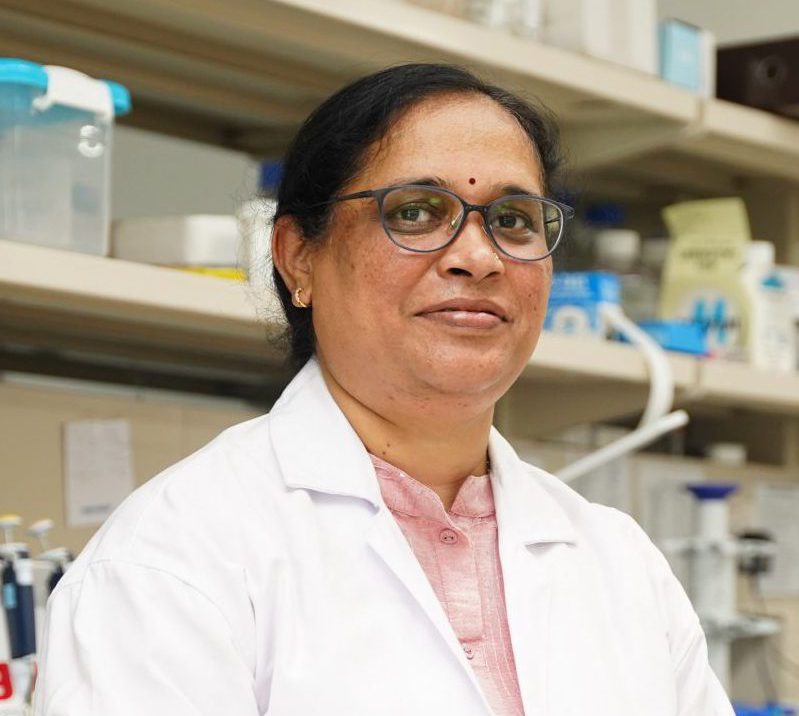
Dr. Latha obtained PhD in from National Brain Research Centre, Manesar. Her work was focused on sex differences in mitochondrial dysfunction and oxidative stress in neurodegenerative disorders. She joined as postdoctoral fellow at National Institute of Mental Health and Neurosciences (NIMHANS) wherein she investigated role of genetics and nutritional factors of high homocysteine in young stroke patients. Later She worked as independent Principal Investigator at Vittal Mallya Scientific Research Foundation, Bengaluru on evaluating many potential drug molecules for chronic inflammatory diseases by getting funding from DST and DBT. Latha joined as Research faculty in TATA grant at Centre for Neuroscience, IISc. Her research was focused on studying molecular mechanisms involved in small vessel alterations in dementia to know the commonality between vasoconstriction and early Alzheimer’s Disease downstream pathways that drive to dementia. Subsequently she joined CBR as faculty member to continue translational research focused on vascular pathology and dementia drawing insights from clinical findings of cohort studies. She worked in collaboration with NIMHANS for Young and Late-Onset Parkinson’s disease (YLOPD) study as PI, funded by SKAN Research Trust. This is a longitudinal study to unravel the underlying Clinical and Genetic differences in Early- and Late-onset of Parkinson’s disease (PD), especially with emphasis on motor and non-motor symptoms. Her research on PD focuses on studying alpha synuclein pathology in mice and cellular systems to decipher the molecular mechanisms in disease progression. She is actively engaged in CBR-cohort research in data analysis in understanding the vascular burden. She is also in-charge for CBR-Biobank technical operations and support.
Research work focused on vascular pathology and dementia:
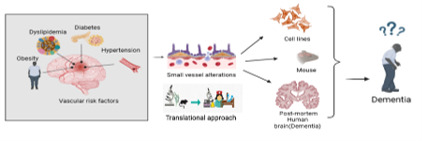
Cognitive impairment associated with aging has emerged as major public health concern with increasing incidence of dementia. Alzheimer’s disease (AD) is known to be the leading cause of clinically diagnosed dementia global, while vascular etiology is the common cause in mixed dementia including AD in south east Asia. Micro-infarcts and micro-bleeds, repeated occurrence of vascular insults in small vessels results in Blood Brain Barrier (BBB) dysfunction potentially contributing to cognitive impairments seen as white matter hyperintensities (WMH) in many dementia patients including AD. CBR-TLSA and SANSCOG cohorts participants have significant vascular burden seen as WMH in MRI. There are multiple risk factors, such as diabetes, hypertension, dyslipidemia, and metabolic syndrome, that significantly accelerate chronic vascular stress and disruption in the BBB integrity.
To understand the molecular mechanisms underlying BBB disruption and identify potential preventive strategies, we employ endothelial cell systems and well-established in vivo mouse models of AD, obese and ApoE4 as well as inhouse developed small vessel vasoconstriction mice model using endothelin-1(ET-1). We also take a translational approach where we extrapolate our findings from the mouse to human brain postmortem tissues to draw parallels between different models. By integrating findings across these models, we aim to map the molecular cascades driving vascular dysfunction in the brain. This integrated approach may help to identify key molecules that may serve as biomarkers for diagnostics and therapeutics in clinical research avenues.
Research work focused on Parkinson’s Disease:
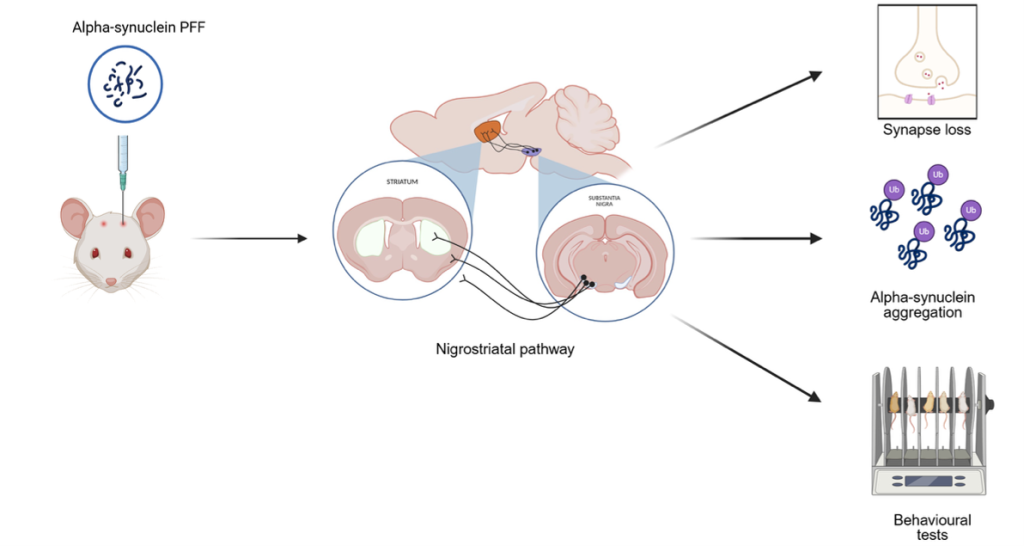
Parkinson’s disease (PD) is a progressive neurodegenerative disorder characterised by the loss of dopamine-producing neurons in the substantia nigra, leading to motor symptoms such as bradykinesia, rigidity, and tremor, as well as non-motor symptoms including cognitive and mood-related changes. Since diagnosis often occurs after substantial neuronal loss, understanding the mechanisms underlying disease progression and identifying early pathological changes remain important challenges. Longitudinal clinical studies have improved our understanding of the prodromal phase of PD, while therapeutic approaches needs deeper delve in to pathology of neural circuitry system such as nigrostriatal pathway at prodromal phase. Our laboratory with the purpose to investigate such cellular and molecular mechanisms in PD progression uses mice and cellular models. In our MPTP-based model, we examine the time-dependent degeneration of dopaminergic neurons and the emergence of motor and non-motor behavioural changes. Behavioural findings are integrated with molecular, biochemical, and histological analyses to assess neuronal integrity and synaptic alterations in the substantia nigra and striatum. Using A53T α-synuclein transgenic mice, we investigate disease progression from early pathological changes to motor dysfunction, with a particular focus on alterations in autophagy and mitophagy and their relationship with α-synuclein pathology, synaptic dysfunction, and dopaminergic neuronal loss. We also use α-synuclein pre-formed fibrils (PFFs) to study the initiation, propagation, and amplification of α-synuclein pathology. Together, these complementary approaches enable us to investigate dopaminergic neurodegeneration, α-synuclein pathology, synaptic dysfunction, and disease progression in PD.


Nayak A, G S, Yenamandra VK, et al. Dual Burden of Kidney Disease and Cognitive Impairment in the Longitudinal Aging Study in India-Diagnostic Assessment of Dementia-Cohort. Kidney Int Rep. 2026;11(9):106688. Published 2026 Jul 1. doi:10.1016/j.ekir.2026.106688.
Ali H, Mondal B, Pinto A, et al. Whole-genome sequencing of 197 cases with Parkinson’s disease reveals novel pathogenic variants in the Indian population. NPJ Parkinsons Dis. Published online July 6, 2026. doi:10.1038/s41531-026-01462-0.
Chatterjee P, Arora S, Rai P, Diwakar L, Issac TG, Sundarakumar JS. Rural-urban differences in lipid abnormalities among middle-aged and older Indians. BMC Public Health. 2025;25(1):2895. Published 2025 Aug 22. doi:10.1186/s12889-025-22625-3
Mallikarjun DN, Malo PK, Mensegere A, et al. Comparison of homocysteine, vitamin B12 and folic acid between rural and urban ageing Indians and its association with mild cognitive impairment and cardiovascular risk factors: a cross-sectional analysis. Brain Commun. 2024;6(5):fcae343. Published 2024 Oct 15. doi:10.1093/braincomms/fcae343.
Sandhya G, Monisha S, Singh S, Stezin A, Diwakar L, Issac TG. Hyperhomocysteinemia and its effect on ageing and language functions – HEAL study. Sci Rep. 2024;14(1):20101. Published 2024 Aug 29. doi:10.1038/s41598-024-69818-1.
Pushpam M, Talukdar A, Anilkumar S, Maurya SK, Issac TG, Diwakar L. Recurrent endothelin-1 mediated vascular insult leads to cognitive impairment protected by trophic factor pleiotrophin. Exp Neurol. 2024;381:114938. doi:10.1016/j.expneurol.2024.114938.
Mallikarjun DN, Jain S, Malo PK, et al. Distribution of biochemical and haematological parameters in an aging population from southern India: A cross-sectional analysis. Ann Clin Biochem. 2024;61(6):451-458. doi:10.1177/00045632241267905.
Kommaddi RP, Gowaikar R, Pa H, Diwakar L, Singh K, Mondal A. Akt activation ameliorates deficits in hippocampal-dependent memory and activity-dependent synaptic protein synthesis in an Alzheimer’s disease mouse model. J Biol Chem. 2024 Jan 3:105619. doi: 10.1016/j.jbc.2023.105619. Epub ahead of print. PMID: 38182004.
Mensegere AL, Sundarakumar JS, Diwakar L, Issac TG; SANSCOG Study Team. Relationship between Framingham Cardiovascular Risk Score and cognitive performance among ageing rural Indian participants: a cross-sectional analysis. BMJ Open. 2023 Nov 10;13(11): e074977. doi: 10.1136/bmjopen-2023-074977. PMID: 37949620; PMCID: PMC10649489.
Kommaddi RP, Verma A, Muniz-Terrera G, Tiwari V, Chithanathan K, Diwakar L, Gowaikar R, Karunakaran S, Malo PK, Graff-Radford NR, Day GS, Laske C, Vöglein J, Nübling G, Ikeuchi T, Kasuga K; Dominantly Inherited Alzheimer Network (DIAN); Ravindranath V. Sex difference in evolution of cognitive decline: studies on mouse model and the Dominantly Inherited Alzheimer Network cohort. Transl Psychiatry. 2023 Apr 12;13(1):123. doi: 10.1038/s41398-023-02411-8. PMID: 37045867; PMCID: PMC10097702.
A HP, Diwakar L, Ravindranath V. Protein Glutathionylation and Glutaredoxin: Role in Neurodegenerative Diseases. Antioxidants (Basel). 2022 Nov 25;11(12):2334. doi: 10.3390/antiox11122334. PMID: 36552543; PMCID: PMC9774553.
Diwakar L, Gowaikar R, Chithanathan K, Gnanabharathi B, Tomar DS, and Ravindranath V. “Endothelin-1 mediated vasoconstriction leads to memory impairment and synaptic dysfunction”. (2021). Scientific reports.org/10.1038/s41598-021-84258-x.
Verma A, Ray A, Bapat D, Diwakar L, Kommaddi R P, Schneider B L, Hirsch E C and Ravindranath V. (2020) Glutaredoxin 1 Downregulation in the Substantia Nigra Leads to Dopaminergic Degeneration in Mice. Movement Disorders. doi:10.1002/(ISSN)1531-8257.
Ahmad F, Das D, Kommaddi RP, Diwakar L, Gowaikar R, Rupanagudi KV, Bennett DA, Ravindranath V. “Isoform-specific hyperactivation of calpain-2 occurs presymptomatically at the synapse in Alzheimer’s disease mice and correlates with memory deficits in human subjects”. Sci Rep. 2018 Sep 3; 8(1):13119. PMID: 30177812
S Shenvi, KR Kiran, K Kumar, L Diwakar, GC Reddy. Synthesis and biological evaluation of boswellic acid-NSAID hybrid molecules as anti-inflammatory and anti-arthritic agents. European journal of medicinal chemistry 98, 170-178. 2015.
Shenvi S, L Diwakar, GC Reddy. Nitro derivatives of naturally occurring β-asarone and their anticancer activity. International journal of medicinal chemistry 2014.
Samaga, L, KK, Rao G.V, Reddy G.C, Kush A.K, Diwakar L. Synthetic racemates of abyssinone I and II induces apoptosis through mitochondrial pathway in human cervix carcinoma cells. Bioorganic Chemistry 56: 54-61. 2014.
Shenvi S, Kumar K, Hatti KS, Rijesh K, Diwakar L, Reddy G.C. Synthesis, anticancer and antioxidant activities of 2,4,5-trimethoxy chalcones and analogues from asaronaldehyde: Sturcture-activity relationship. European Journal of Medicinal Chemistry 62 435-442. 2013.
Diwakar L, Rudresh Kumar KJ, Bachnalkar A, Ravindranath V, Christopher R, Nagaraja D. The influence of MTR A2756G polymorphism on plasma homocysteine in young south Indians. ClinChimActa. 395, 172-174. 2008.
Diwakar L, Ray A, Ravindranath V, Complex I assay in mitochondrial preparations from CNS. Curr.Protoc. Toxicol 38:17.10. 1-17.
Diwakar L, Ravindranath V, Inhibition of cystathionine-gamma-lyase leads to loss of glutathione and aggravation of mitochondrial dysfunction mediated by excitatory amino acid in the CNS. Neurochem Int. 50, 418-426. 2007.
Diwakar L, Kenchappa RS, Annepu J, Ravindranath V, Downregulation of Glutaredoxin but not glutathione loss leads to mitochondrial dysfunction in female mice CNS: Implications in excitotoxicity. Neurochem Int.51, 37-46. 2007.
Diwakar L, Kenchappa RS, Annepu J, Saeed U, Sujanitha R, Ravindranath V, Down-regulation of glutaredoxin by estrogen receptor antagonist renders female mice susceptible to excitatory amino acid mediated complex I inhibition in CNS. Brain Res.1125(1):176-184. 2006.
Karunakaran S, Diwakar L, Saeed U, Agarwal V, Ramakrishnan S, Iyengar S, and Ravindranath V. Activation of apoptosis signal regulating kinase 1(ASK1) and translocation of death-associated protein, Daxx, in substantianigra pars compacta in a mouse model of Parkinson’s disease: protection by alpha-lipoic acid. FASEB J. 21:2226- 36. 2007.
Kenchappa RS, Diwakar L, Annepu J, Ravindranath V, Estrogen and neuroprotection: higher constitutive expression of glutaredoxin in female mice offers protection against MPTP-mediated neurodegeneration. FASEB J. 18:1102-1114. 2004.
Devi L, Diwakar L, Raju TR, Kutty BM, Selective neurodegeneration of hippocampus and entorhinal cortex correlates with spatial learning impairments in rats with bilateral ibotenate lesions of ventral subiculum. Brain Res. 960:9-15. 2003.
Kenchappa RS, Diwakar L, Boyd MR, Ravindranath V, Thioltransferase (glutaredoxin) mediates recovery of motor neurons from excitotoxic mitochondrial injury. J Neurosci. 22:8402-8410. 2002.
-
Centre for Brain Research
Indian Institute of Science Campus
CV Raman Avenue
Bangalore 560012, India. - +91 80 2293 3588
