
The CBR Biomarker CoE

The long-term goal of CBR is to enable ‘healthy aging’ through significant contribution to minimising the burden of neurodegenerative diseases. CBR is presently working on developing a composite biomarker for early detection of dementia and design scalable interventions to prevent/postpone dementia. Towards this, the Centre integrates expertise in neuroscience, clinical research, genomics, data science, and engineering to advance early diagnosis, prevention, and intervention strategies. CBR’s large-scale cohort studies, multidisciplinary research, and commitment to innovative partnerships place it at the forefront of aging brain research in India.
CBR has embarked on setting up a Biomarker Centre of Excellence in collaboration with the UK Dementia Research Institute (UK DRI) and with support from Gates Ventures and Pratiksha Trust. This ambitious initiative aims to establish a sophisticated platform for the discovery and validation of neurodegenerative disease biomarkers. In addition to plasma biomarkers, the Centre will also explore digital biomarkers to build a more comprehensive understanding of disease onset and progression.
A unique strength of this Centre of Excellence is that it will function under the scientific guidance of Professor Henrik Zetterberg (UK DRI and University of Gothenburg), a globally recognised pioneer in biomarker research, and Professor Siddharthan Chandran, Director of the UK DRI, both of whom are Visiting Faculty Members at CBR. By working closely with Professors Zetterberg and Chandran, the Centre will integrate the state-of-the-art in fluid biomarker assays, high-throughput proteomics, and AI-driven analytics with unique, diverse cohorts from India and the UK in order to accelerate breakthroughs in early diagnosis. The Centre of Excellence will foster cross-institutional partnerships, training, and knowledge exchange to build capacity and advance global brain health research.
Fluid Protein Biomarker Facilities
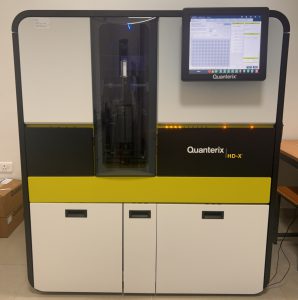
Simoa HD-X Automated Immunoassay Analyzer (Quanterix)
A novel, cutting-edge, ultrasensitive, and fully automated digital immunoassay analyzer with single-molecule sensitivity and multiplexing capability. The Simoa HD-X enables best-in-class assay performance for quantification of protein biomarkers in small volumes of biofluid. Single- and multi-plex assays can be performed across several areas of medical research.
| Features | Description |
| Sample type | Plasma, serum, cerebrospinal fluid (CSF), Dried Blood Spot (DBS) extractions, Dried Plasma Spot (DPS) extractions, brain tissue lysates, saliva, tears, sweat |
| Technology | Digital ELISA |
| Quantification | Absolute (pg/mL) |
| Sample capacity per run | 34 (duplicates) / 96 well format |
| Sample volume | Multiplex (~100 µL) |
| Single-plex (~100 µL) | |
| Time | ~4 hrs |
| Precision | Very high (~5-10% CVs) |
| Sensitivity | up to 1000-fold; femtomolar to attomolar |
| Specificity | Very high |
| Limit of detection (LoD) | 0.001 – 0.1 pg/mL |
| Detectability (%) | >99 |
| Scalability | Suits large cohort and clinical-trial samples |
Applications
- Neurology: Detection of neurodegenerative disease biomarkers (e.g., pTau-217, pTau-181, pTau-231, BD-Tau, Aβ40, Aβ42, GFAP, NfL) in blood or CSF for Alzheimer’s, Parkinson’s, ALS, and multiple sclerosis studies.
- Translational and clinical research: Bridging the gap from bench to bedside by enabling biomarker validation in blood, plasma, serum, or other body fluids.
- Rare disease research: Detecting extremely low-abundance proteins where traditional assays lack sensitivity.
- Oncology
- Infectious disease
- Cardiology
- Immunology and inflammation
- Pharmacokinetics and drug development
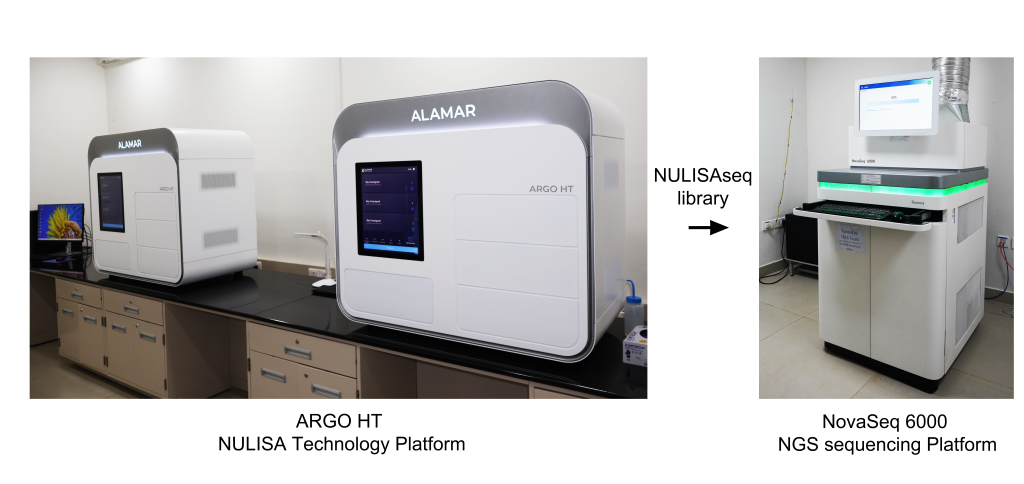
ARGO-HT (NULISA Technology, Alamar Biosciences)
The ARGO HT System is a fully automated, high-throughput precision proteomics platform that performs ultra-high sensitivity and high multiplexed analysis through the NUcleic acid Linked Immuno-Sandwich Assay (NULISA) technology. It has been engineered for precision and designed for next-generation proteomics and integrated seamless workflows and unparalleled efficiency. The NULISA technology combines a sequential immunocomplex capture-and-release mechanism with next-generation sequencing to quantify proteins at attomolar-level sensitivity. It is compatible for multiplex and single-plex assays.
Applications
- Biomarker discovery
- Neurodegeneration and Alzheimer’s research
- Translational studies and drug development
| Features | Description |
| Sample type | Plasma, serum, cerebrospinal fluid (CSF), Dried Blood Spot (DBS) extractions, saliva, brain lysates, tear fluid, and nasal swabs |
| Sample volume | Multiplex (25 µL) |
| Single-plex (35 µL) | |
| Time | Multiplex ~16 hrs |
| Single-plex ~8 hrs | |
| Precision | Very high (~6% CVs) |
| Sensitivity | up to 10000-fold |
| Specificity | Very high |
| Dynamic range | Single-plex (up to 7 logs) |
| Multiplex (up to 12 logs) | |
| Limit of detection (LoD) | Attomolar (up to fg/mL) |
| Detectability (%) | >99 |
| Scalability | Suits large cohort and clinical-trial samples |
Olink Explore HT
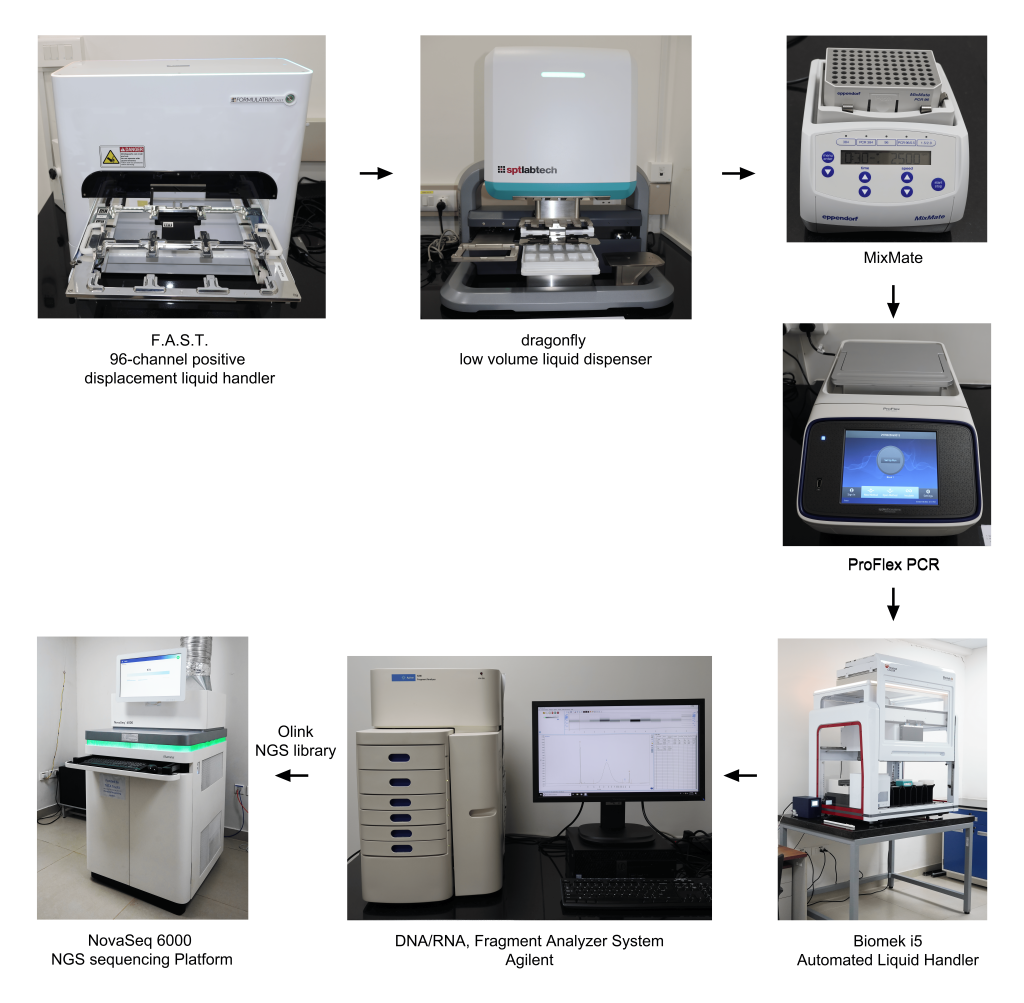
The Olink Explore HT is a high-throughput proteomics platform for measuring several thousands of proteins in a small blood sample volume. This technology utilizes the Proximity Extension Assay (PEA) technology followed by next-generation sequencing (NGS) for detection of proteins. Olink Explore-HT’s seamless workflow with high-throughput automated instruments (Dragonfly discovery from SPT Labtech, FAST from Formulatrix, Biomek i5 from Beckman, and NovaSeq 6000 from Illumina) has been well established. Further, it has been proven to possess exceptional specificity and sensitivity, enabling high multiplex assays with coverage across a broad dynamic range (10 logs) for discovery proteomics.
Applications
- Population and cohort studies
- Biomarker discovery
- Multi-omics integration
- Target discovery and drug development
- Disease-specific investigations
- Clinical translation
| Features | Description |
| Sample type | Plasma, serum, cerebrospinal fluid (CSF), Dried Blood Spot (DBS) extractions |
| Coverage | 5400+ proteins |
| Sample capacity per run | 172 |
| Sample volume | 11 µL |
| Time | 72 hours |
| Specificity | Reduces off-target signal |
| Quantification | Relative (NPX, log2) |
| Strength | Specificity from two binders, small volume |
| Scalability | Suits large cohort and clinical-trial samples |
